Tasks
Set it, do it, sign it off.
A task is a job with an end — asked for, done, proved and ruled on. Not a to-do list with one box to tick, but a loop that only closes when the other person says it has.
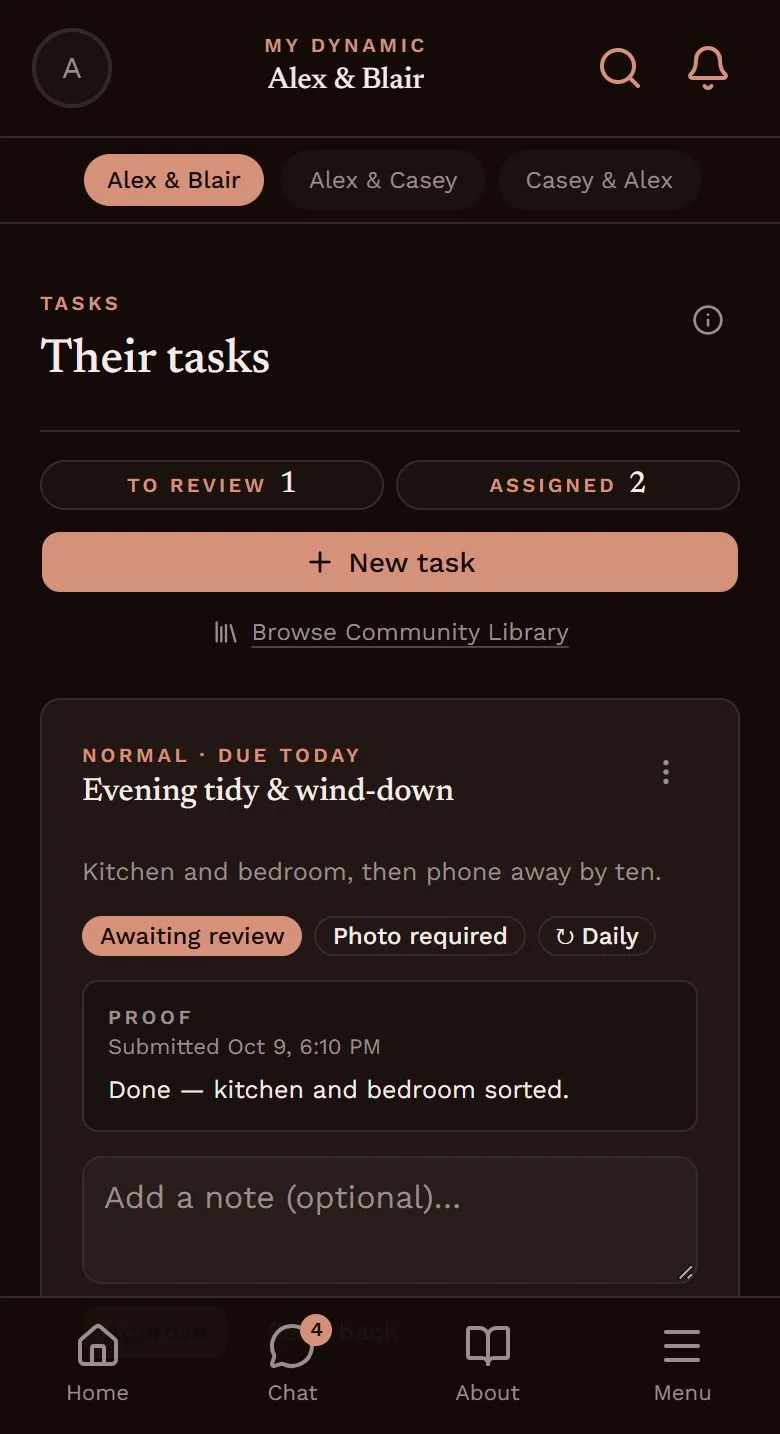
You set the task, then sign it off — or send it back with a reason.
Free, photo proof included. Keeping proof photos is on the paid plan. See pricing
A task is finished when the other person says so
Anyone can write a to-do list. What a list cannot do is close the loop — it has one box, you tick it, and whether the thing was actually done to anybody’s satisfaction is a conversation that happens somewhere else, or does not happen at all.
Here a task is set with a title, whatever detail is needed and a due date. It is done, and then it is submitted — with a photograph or a short video where that is the point of it. It sits in a review queue until it is approved or sent back, and if it comes back it comes back with a reason and the task stays live under “try again”. Nothing is quietly marked complete by the person who did it.
Sent back is not the same answer as no, and the app never draws them the same way.
Proof is a photograph taken, not chosen. The camera opens rather than the photo library, deliberately: proof of a task is a picture of how things are now, and a picker turns it into a picture of any moment at all. Once it has been reviewed the photograph is deleted — it existed to be looked at, not to be kept — unless you both choose to keep proof photos, which is part of the paid plan.
Tasks that come round again are set once. A weekly job repeats on its own, arrives on the calendar and turns up in the day’s work without anybody re-typing it, and the record of every past one stays where you can read it.
Two screens, one for each of you
The Dominant sees what is waiting for review first — the thing that needs a decision — and what is still out on the other person’s plate underneath it. The submissive sees what is due, what has been sent back, and what is waiting to be looked at. Neither of you has to ask the other where something has got to.
A task can be as small as watering the plants on Friday or as particular as a photograph of the finished kitchen by seven. What makes it work is that it says exactly what “done” means before anybody starts, and that the answer to it — approved, or sent back with a reason — is written down beside it.
What it adds up to
Over thirty days the tasks become a follow-through figure — how many of the things that were asked for actually got ruled on. It feeds the week’s score on the home screen, which opens out into what it was made of rather than being a number you have to take on trust.
And an approved task is a moment somebody can say thank you for, with a reward handed down from its own button on Home. That lives on goals, rewards and ideas; for the standing things that happen every day rather than once, see protocols.