Asks
Ask, and get a real answer.
What is not a standing rule gets asked for — and answered properly. Yes, no, or yes with a condition and a time on it, all kept on a record neither of you can rewrite afterwards.
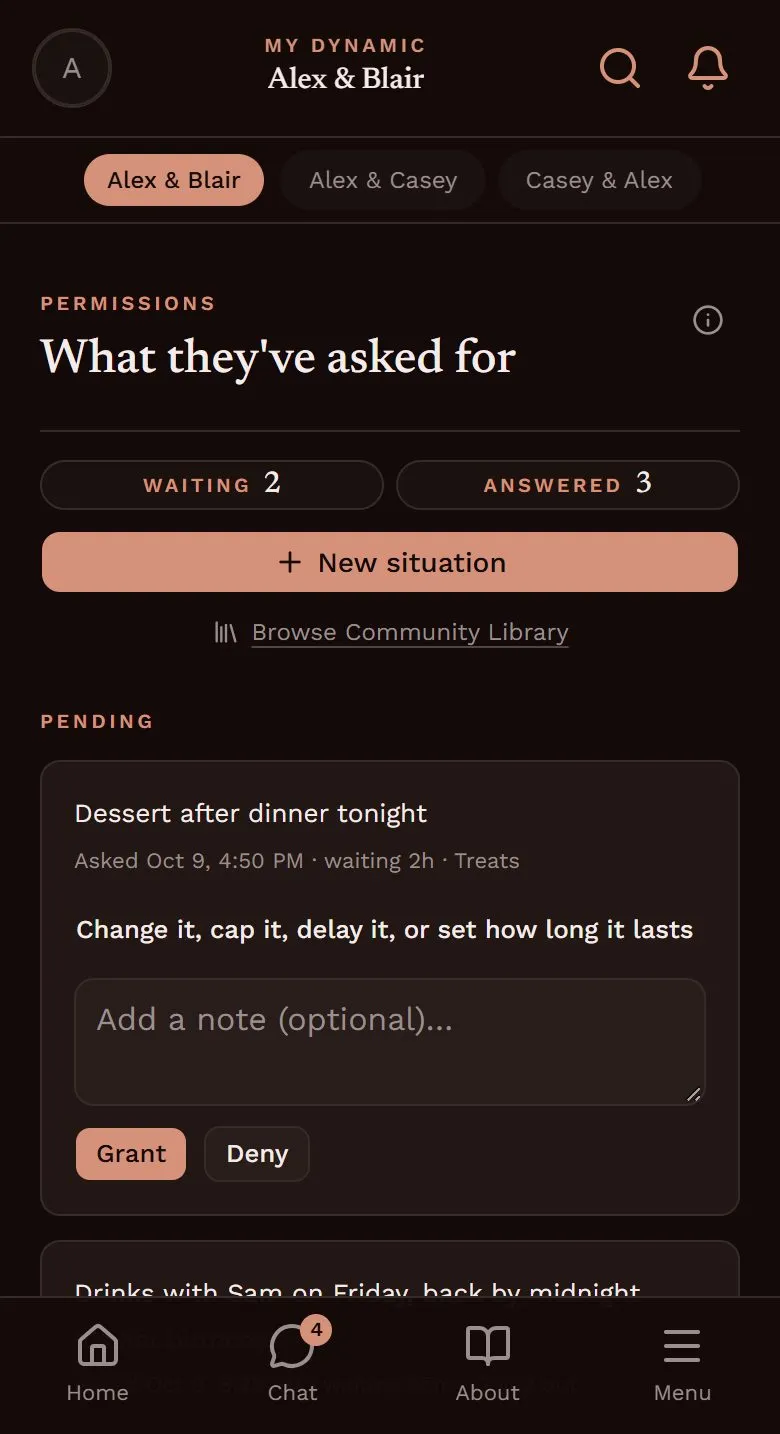
Ask, and get a real answer
The things that are not standing rules get asked for. An ask is a sentence and a note; the answer is yes or no — or, far more usefully, something in between.
Yes, but be back by eleven.
Half of what a real answer looks like is a counter-offer, and with nowhere to put the “but” it used to end up in a comment while the request itself still said midnight was granted. So the Dominant can reshape an ask in the act of answering it — and only then. The original is kept and shown struck through, and the notification carries the wording that was actually agreed rather than the one that was asked for.
A yes can also have an end on it: tonight, an hour, or until a date. That, too, can only be set while granting — a yes that quietly became “yes, until Tuesday” a week later would already have been announced as an unqualified yes. Nothing sweeps it and nothing is revoked; the record simply stops overstating what was agreed, and reads “ran out” rather than “granted”.
The ones you ask for over and over
Standing situations are the asks that come round — going out, staying over, buying something. Each is named once, and each can carry an instruction saying what a good ask for it looks like: always give me a return time, and ask before you leave.
That instruction is shown while the ask is being written, not filed somewhere to be looked up. A standard nobody reads at the moment it applies is a document, not a standard.
Every ask and every answer stays on the record afterwards, longest-waiting first so the one that has been sitting there is the one you see. A denied or expired ask offers to ask again, prefilled — because that is the moment somebody wants to.
Why asking is worth writing down
Asking permission is one of the most ordinary parts of a D/s dynamic and one of the easiest to lose track of. A yes given in passing on a Tuesday is remembered differently by Friday. Written down, with its conditions and its end, it is the same yes for both of you — and a no is just as clear, without anybody having to say it twice.
It works the other way too. The submissive can see, in one place, what is waiting, what was granted and until when, and what ran out — so nobody has to guess whether last week’s permission still holds.