Rules
In writing, and never changed quietly.
A rule is what stands without being asked. It is kept as a record neither of you can rewrite afterwards — which is the only thing that makes it worth agreeing to.
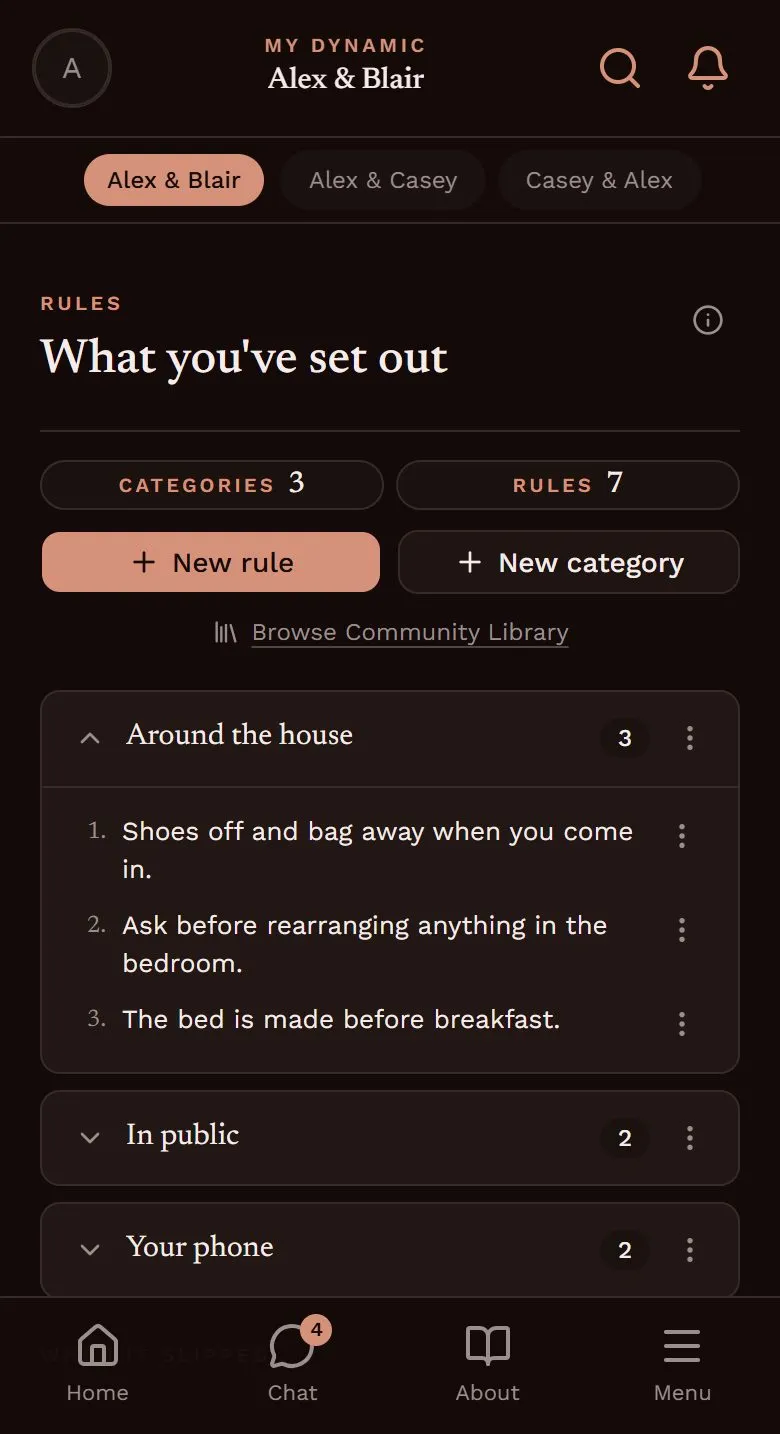
Rules are grouped, written down, and announce their own changes
Rules live in groups you name — around the house, in public, about your phone — because a flat list of thirty things is a list nobody rereads. Each one is a sentence. There is no scoring, no streak and no daily tick: a rule is not a chore, it is the shape of how you already live.
What makes them different from a note in your phone is that a change is an event. Add one, remove one or reword one and the other person is told — and a reword carries the previous wording with it, because the notification is the only record of what a rule used to say.
Nothing here can be edited in the night and presented in the morning as what was always agreed.
A rule that can be broken
For a long time a rule could be written and then had no relationship with what actually happened — the app could not tell one kept perfectly for six months from one broken every day. A breach can now be reported, and either of you can report it.
The submissive owning up is the half that makes this belong in an app like this one rather than in a demerit tracker. It is stamped as self-reported so it can never blur into having been caught, and neither side can forge which it was.
A breach is then ruled on: acknowledged, dismissed, or talked over. The third is not a softer version of the first two — it opens the chat with the rule quoted, rules on nothing, and leaves the breach waiting. A conversation is not a decision, and an app that made you pick a verdict in order to have one would get fewer honest reports.
A consequence can be attached, drawn from a list you agreed in advance, and it is written into the record as it stood — so tidying that list later cannot rewrite what was actually handed down. Right after a ruling that stands, the app asks whether to assign one.
Consequences have a place of their own, reached from Home, rather than sitting among the tasks. The Dominant hands one down and keeps an eye on what is still open; the submissive has their own read of theirs. A restriction has a start and an end, and counts down live on Home while it runs.
You do not have to think of it all yourselves
A blank rules screen on the first evening is the hardest thing about starting. There is a shared library to take from — rules, tasks and protocols other people have written and contributed — so the first version of your arrangement is something you edit rather than something you invent.
Anything taken from it becomes yours immediately: reworded, grouped and applied however you like, with no link back to where it came from. It is a starting point, not a template you are stuck inside.
And what is not a rule
A rule covers what stands without being asked. Everything that has to be asked for first — going out, staying over, a treat, a purchase — is an ask, with an answer written down beside it.