Check-ins
Say how you’re really doing.
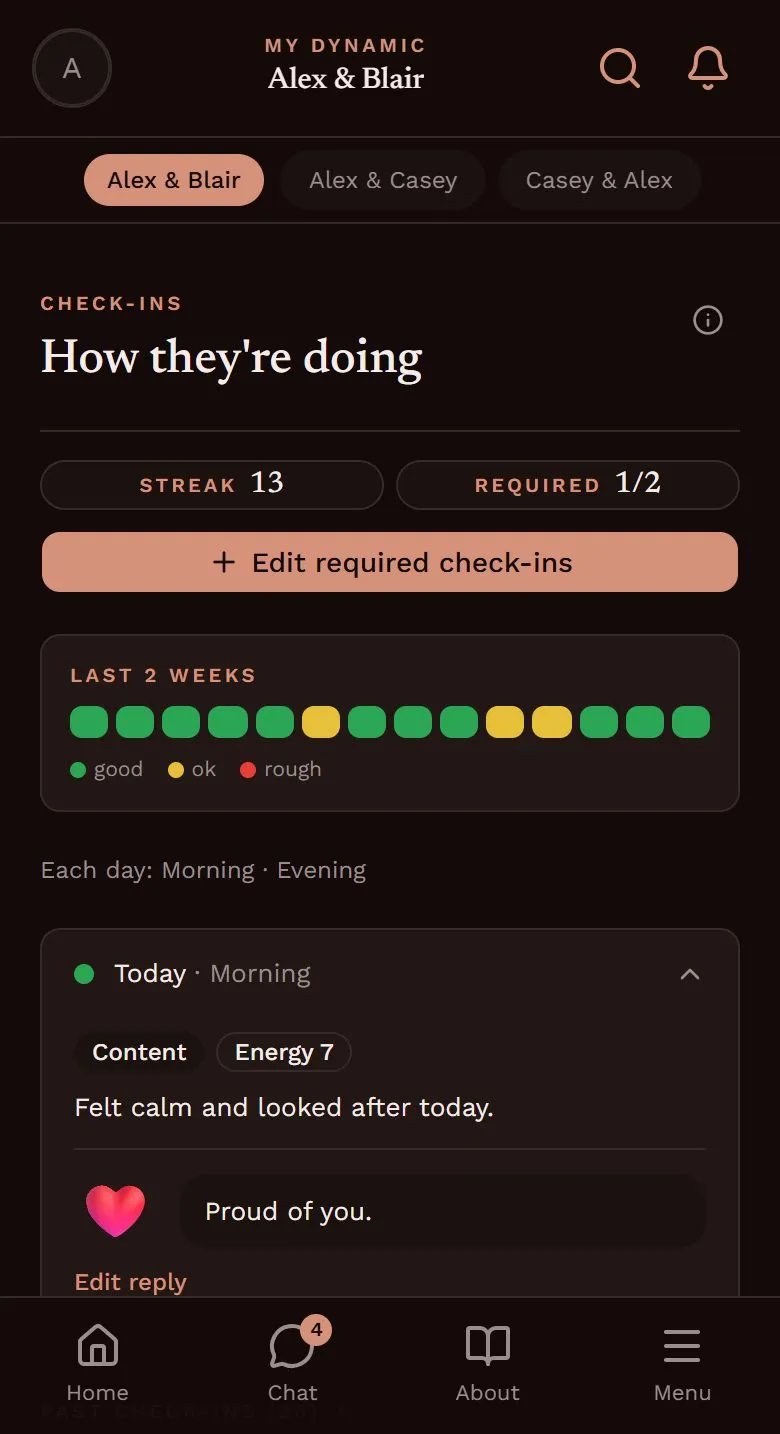
The welfare half, and the half most apps like this leave out. Named check-ins with an instruction on each, answered and answerable, and a fortnight of how it has actually been going that neither of you has to remember.
A check-in is a named thing, not a number
“Three check-ins a day” leaves three of what written down nowhere. Here each one has a name — Morning, Before bed, After a scene — and each carries its own instruction, shown while it is being filled in.
The Dominant decides what each one has to collect. A photograph, a mood, an energy level, where you are on the scale of wanting — any of them can be required, and the rest stay available to somebody who wants to say more. Required means the floor, not the form.
Nothing pre-fills itself with a number nobody chose. An untouched slider that quietly recorded a five was the single worst thing this screen ever did: it made “I filled nothing in” indistinguishable from a considered answer, and everything downstream read it as a good day.
Answered, and answerable
A check-in is read and replied to — with words, an emoji, or both. Once it has been answered the entry closes to editing, which is what makes it a record rather than a draft.
But a reply that ends in a question used to arrive somewhere with nowhere to answer it. So any reply can be taken into the chat, with the check-in quoted above the box — dated absolutely, because it will be read hours later by somebody for whom “yesterday” means a different day.
The quote is not part of the draft, so the one thing on screen that is somebody else’s words cannot be reworded before being sent back to them.
A fortnight, at a glance
Every check-in resolves to a tone — good, rough, or nothing said — and a fortnight of them sits at the top of the screen as a strip of colour. It is the fastest honest answer to “how has this month actually been”, and it is the thing neither of you can reconstruct from memory without flattering it.
A day nobody said anything on is drawn as nothing said, never as a good day. That sounds obvious and was not: an entry naming neither a mood nor an energy used to count as good, on the reasoning that somebody who did not report low energy was not having a low day — which held right up until a check-in could require nothing at all.
After a run of rough days the Dominant gets a quiet heads-up. Not an alarm, and not a number: a note that opens onto the days it is about.
Never frozen
One last thing, and it is a rule rather than a nicety: welfare data is never frozen. Pause the dynamic and tasks stop, rules stop, enforcement stops — while check-ins and journals stay open, because a pause is often exactly when somebody most needs to say how they are.