Protocols
Every day, the same shape.
A task has an end. A protocol is how a day is meant to go — every day, set once, with a streak that counts fairly and room for the days when life gets in the way.
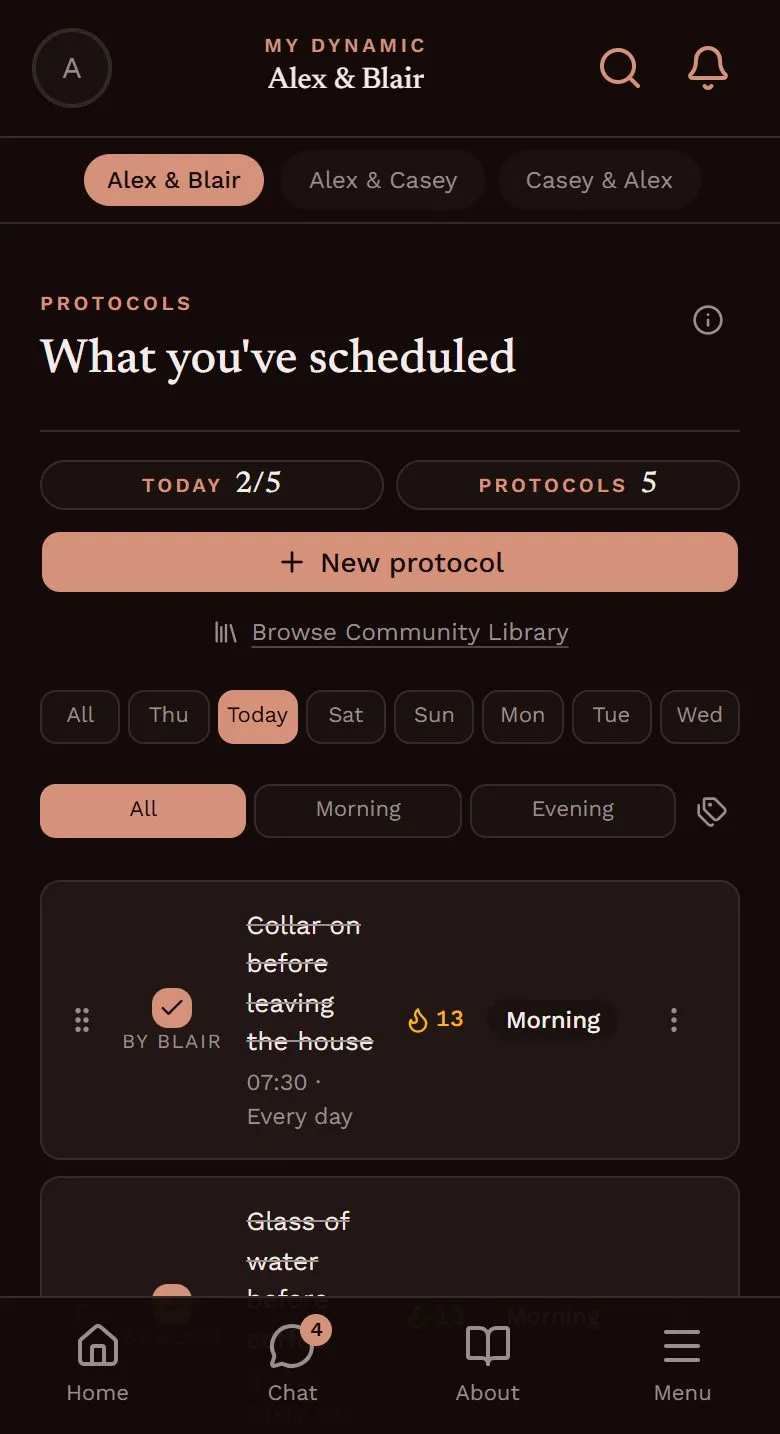
You set the daily protocols and watch the streak.
Protocols are free. Photo proof, asking to skip or pause a day, rulings on a missed day, and a submissive's own protocols alongside a partner are on the paid plan. See pricing
A protocol is the shape of a day
Protocols are the standing things — how you wake, what you wear, what you say, the fifteen minutes that belong to somebody else. They are not tasks, because a task that recurs forever is a badly-shaped protocol: it has a due date it does not need, a review it does not want, and a completed-tasks list it slowly fills with noise.
So they get their own screen and their own arithmetic. Each one says which days it applies on. Today shows what is left. And the number the screen leads with is a streak — the run of days you have kept them — because that is the question somebody actually opens this screen asking.
A day with nothing due neither breaks the streak nor extends it.
That rule matters more than it sounds. A weekday protocol cannot be failed on a Sunday, so a Sunday must not end the run — but counting it would inflate a twenty-day streak out of a fortnight of doing anything. And today can only ever add to a streak, never end it: at eight in the morning nothing is done yet, and a screen reading “no streak” until the evening would be lying about a month of keeping something up.
Life gets in the way, and that is a thing to say out loud
A protocol that cannot be missed becomes a protocol that gets quietly abandoned. So a skip can be asked for — with a reason — and approved or refused. An approved skip is not a miss: it comes out of what was due that day, so it costs nothing in the streak, nothing in the percentage, and nothing in the week’s score. It is on the record as a decision somebody made rather than as a day that went wrong.
The morning after, anything nobody marked either way is asked about once. Not done, or never said? A day rolls over and the difference between those two is lost forever, so there is exactly one chance to settle it — and answering “I didn’t” is recorded as an answer rather than as silence, which is why the question stops coming back.
Some of them are nobody else’s business
Not every standing habit is one that was handed down. Water before coffee, ten minutes tidying, the thing you are trying to be better about — you can add your own, and choose whether your Dominant sees it. Hidden means hidden: it is enforced by the database rather than by the screen politely not drawing it.
A protocol you wrote is yours to reword, pause, hide and delete. One written for you is not, however much of it is about you. That split is the same one everywhere in the app, and it is the reason there is no “personal” flag to turn on: who made a thing is already the answer.
What it adds up to
Over thirty days the protocols become an adherence figure — how much of what was due actually got kept. It feeds the week’s score on the home screen, which opens out into what it was made of rather than being a number you have to take on trust.
None of it counts a day you were not able to use the app. That is a deliberate piece of arithmetic rather than an oversight: a scoreboard that punishes somebody twice is a scoreboard nobody believes the third time.