Chat
A conversation, with nothing to fill in.
Not everything is a ruling. Somewhere to simply talk — with nothing to fill in first, both voices equal, and still open through a pause or a lapsed subscription.
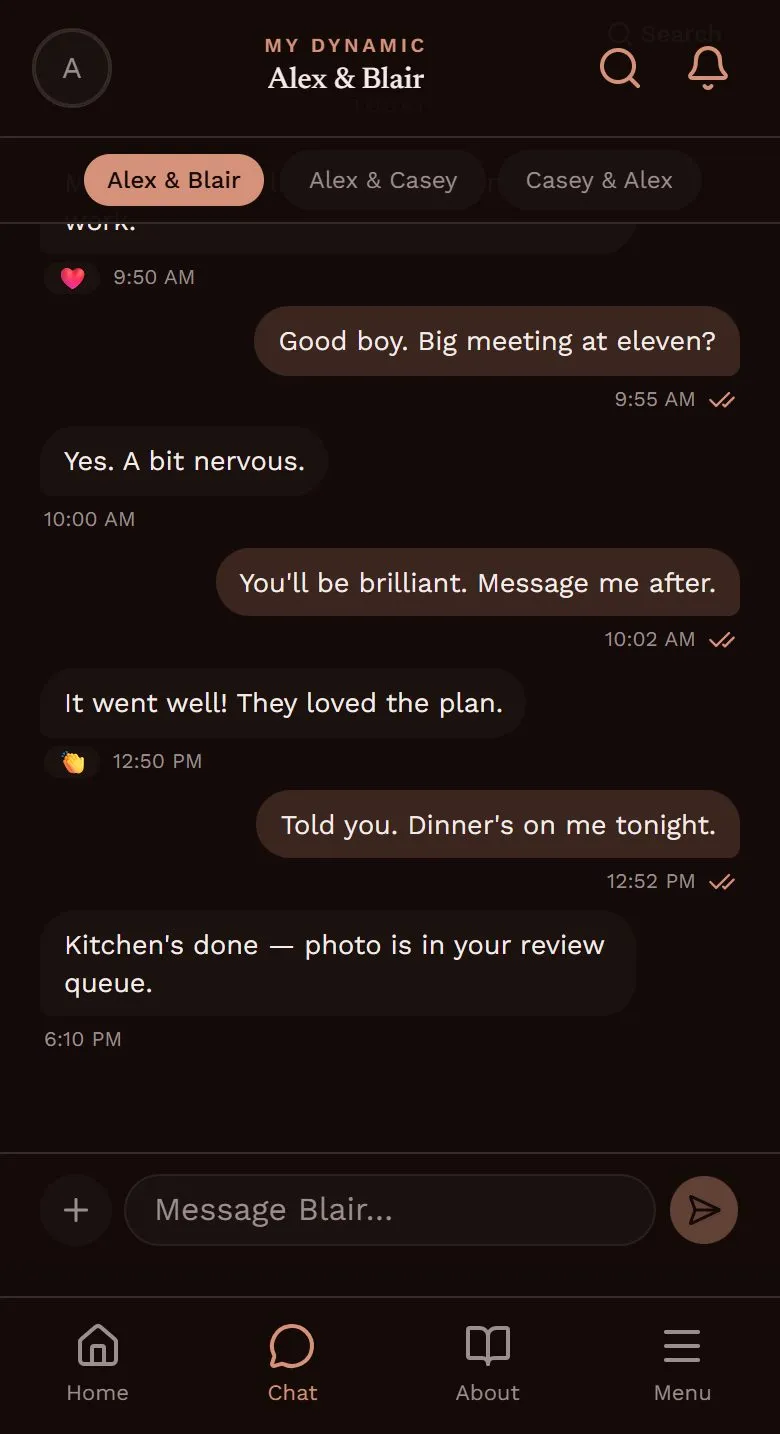
A conversation, with no form attached
Every other screen here is a record with a decision on it — a task and its ruling, a check-in and its reply, an ask and its answer. All of that is the two of you communicating, and all of it makes you fill something in first. The chat is the other thing: a line of text or a photograph, from either side, in order.
It survives a pause, as check-ins and the journal do. A pause, an argument or a lapsed subscription are the moments two people most need to be able to talk, and a conversation that can be switched off is not one. The one thing that does quieten it is a silence the Dominant sets on purpose, for a time, and says so.
It is also the one thing here you can take back or fix. Your own messages are yours to delete or reword, whichever role you hold — the single place where the Dominant-can-do-more asymmetry does not apply. An edit says “edited” beside the time, on both sides, from the first one onwards: what protects the record is visibility, not refusal.
There is no “message deleted” line, because that is the message still being there, saying that it was.
Read receipts run both ways or not at all. A receipt travelling one direction in a relationship shaped like this one would be surveillance rather than a courtesy. And when something you said has been read and not answered, there is a nudge — once per message, only about the newest thing in the conversation, and only once they have actually seen it. It is the small honest version of sending the same message again.
Saying the kind thing
Almost every warm thing in an app like this is a by-product of paperwork — approval on a task, a good ruling, a milestone reached. Express a Feeling is the one thing here with nothing underneath it: a few words, sent because you wanted to send them, arriving on their own. It is one button, and what you pick inside it is the tone — a warm word or a harder one.
A warm word can be answered with a single face, and that answer comes back as its own small piece of news. Beside it sits the opposite: a silence, which takes the app away from them until it is lifted. Changing your mind is delivered; taking it back is not, because a notification saying somebody un-reacted would be a small cruelty about nothing.