Calendar
One week, for both of you.
Scenes, rituals, dates that matter and anything with a due date, all on one calendar the two of you share — shown beside the real one you already live by, with a line saying where each of you is right now.
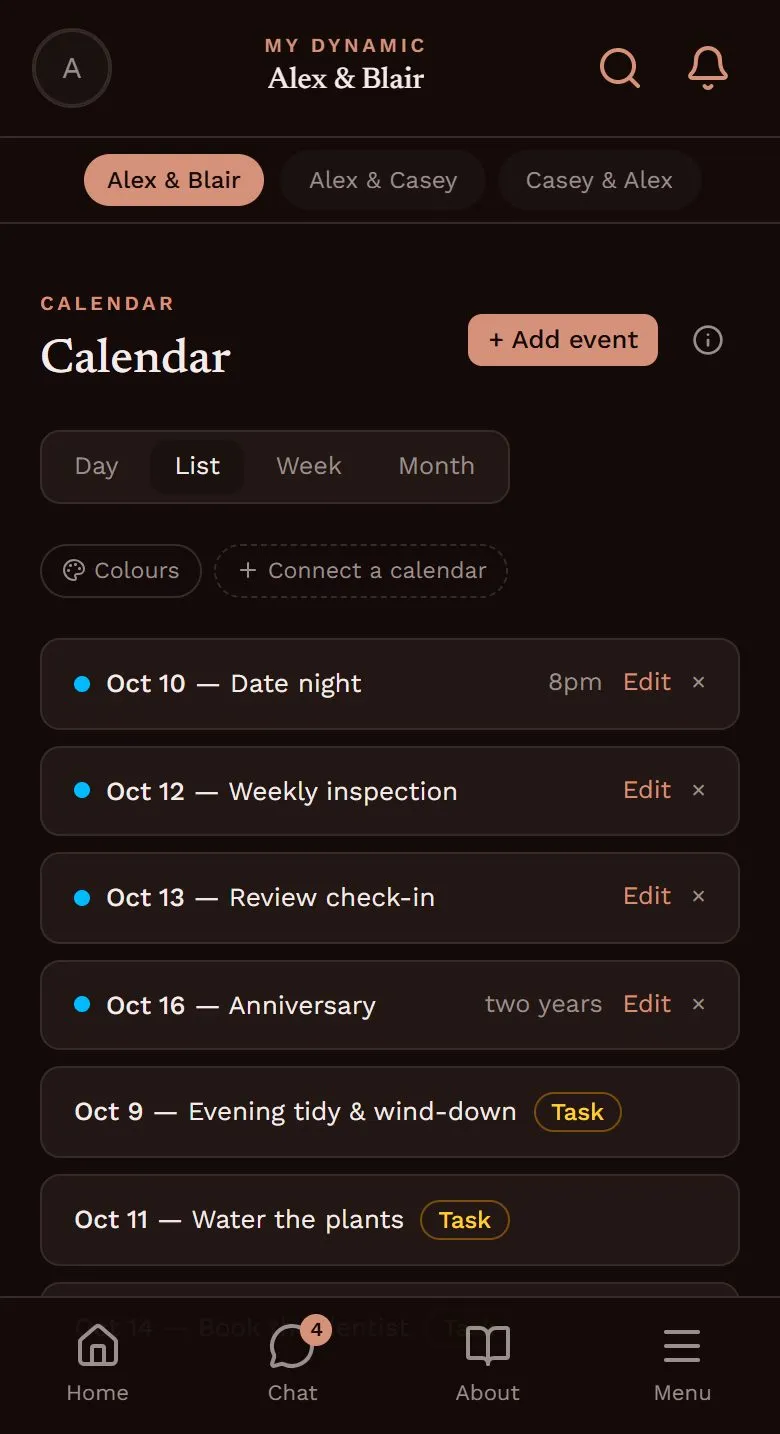
A calendar that knows about the rest of your life
What makes it usable rather than a second diary to cross-reference is that it can read your real one. Google, Apple or Outlook, through the private subscription address those calendars already publish — so there is no account to connect and no permission granted over your whole mailbox.
It is read-only, in one direction, permanently. Nothing this app knows is ever written back to your work calendar. And each connected calendar is set separately per relationship: whether it appears here at all, and whether your partner can see it, are two different switches — because a work calendar can be useful beside one relationship’s week and nobody else’s business beside another.
Saying where you are, without having to say it
Underneath the two of you sits one line each: where you say you are. It can be typed by hand, in your own words, and it can also say itself — set a weekly schedule once, office, nine to five, weekdays, and it holds until the next boundary you were going to cross anyway, without either of you touching the app all day.
A hand-picked word lasts until the next boundary that was going to happen anyway — not an hour, not midnight.
It is built for a life that is not a straight line: a block can cross midnight, and a single event on the shared calendar can carry its own status for its own window. Your partner can look at your whole week — not to check on you, but because “why does it say that” is the question a location is drawn to answer. What they cannot see is the list of words you wrote for yourself and never chose, which stays exactly as private as everything else you write about yourself.
Repeating things, set once
A weekly inspection, a monthly review, an anniversary — anything that comes round again is set once and repeats on its own. Recurring tasks arrive on the calendar the same way, so the week ahead shows what is actually coming rather than what somebody remembered to add.