Privacy & control
Kept between you, and provably so.
What is written here is not read by anybody outside your dynamic. That is enforced by the database on every single request rather than promised by the screen, which is a different kind of claim.
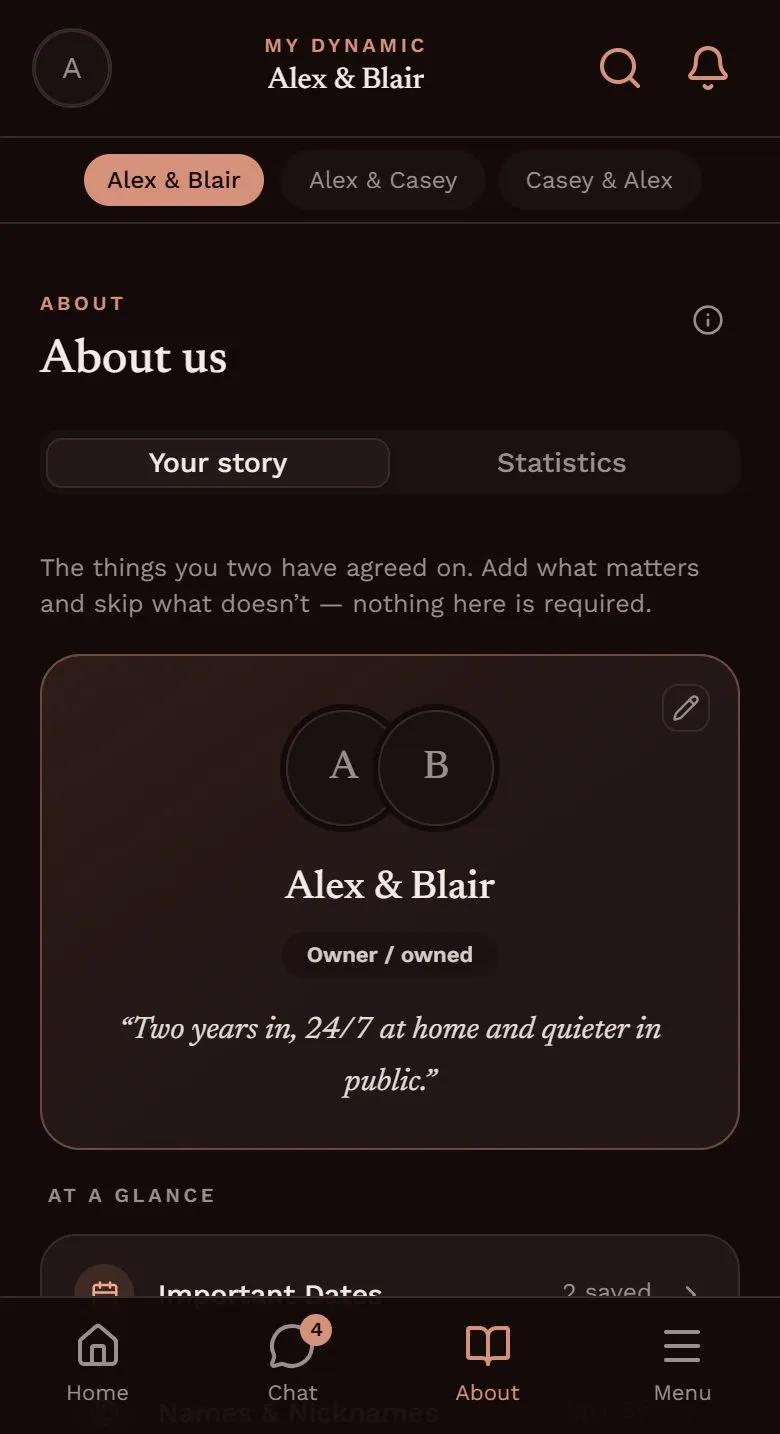
Limits, safewords and your story, written down.
The screen is not what keeps a secret
There is no server in the middle of this app deciding who may see what. Every question of the form may this person read this row is answered by the database itself, on every request, regardless of what the app on your phone believes about itself.
That distinction is the whole of it. A rule enforced by an app is a rule that holds until somebody uses something other than the app. A protocol you have hidden from your Dominant is not merely undrawn — it is unreadable. A connected calendar you have not shared is not filtered out on the way in; it never leaves the database.
Rules enforced only in the interface are not enforced. They are a request.
Everything agreed, written down before it is needed
Limits, safewords, aftercare, the things that are never on the table — written down and kept where both of you can find them, rather than in a conversation you had once and remember differently.
Alongside them, the dates that matter, and where the two of you stand: a status you move between by proposing and agreeing, so nobody arrives at a new understanding of the relationship on their own.
Either of you can stop, instantly
Pausing takes one tap and needs nobody’s approval — not the Dominant’s. New assignments and enforcement stop; check-ins and journals stay open, so you can carry on looking after each other while nothing is being asked of anybody.
Ending is the same: available to both of you, at any time, from your own profile. Even somebody who has been shut out of the app entirely can still reach the way out of a relationship — which is deliberate, and is the sort of thing that has to be decided in advance rather than discovered.
More than one, kept apart
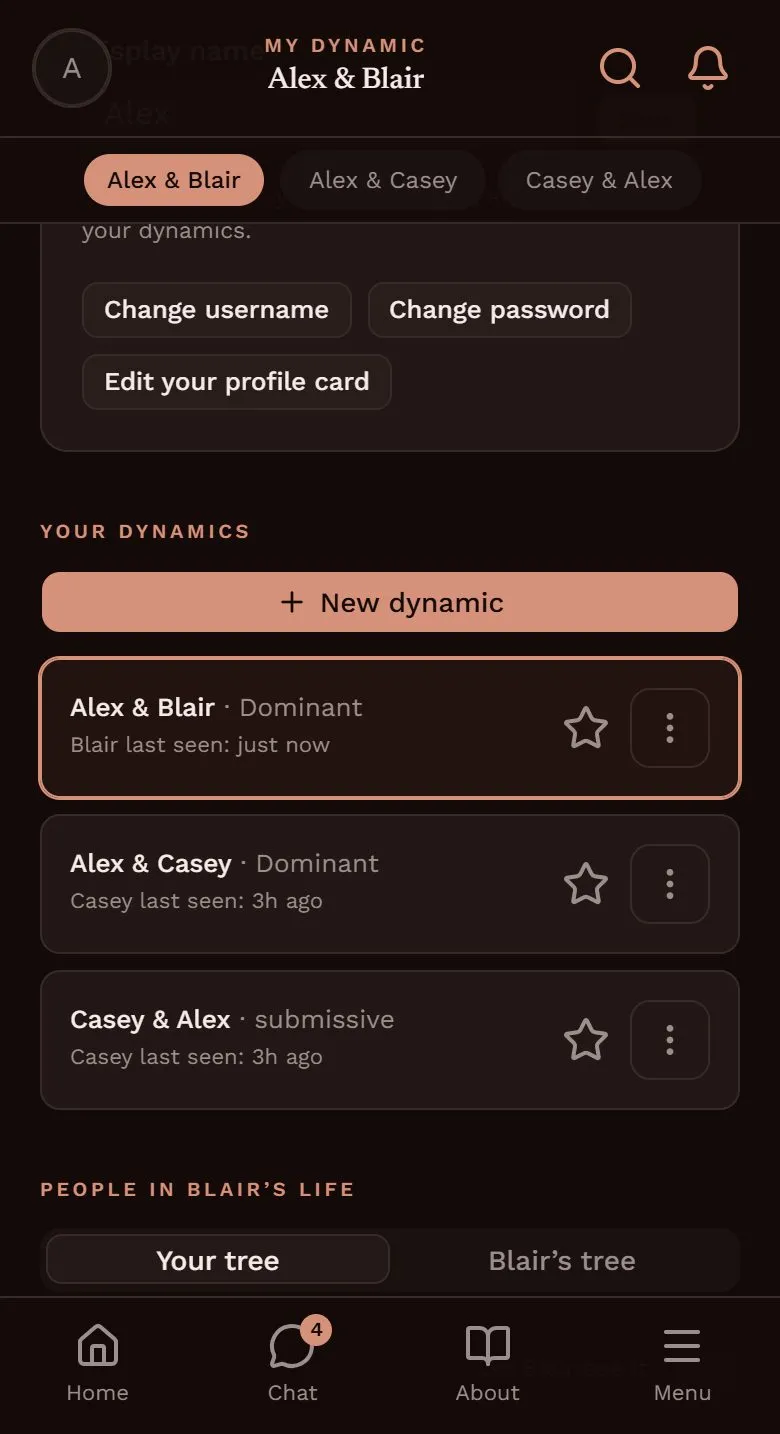
One account can hold more than one relationship, and they do not leak into each other. Different rules, different protocols, different history — and a different colour, so you know which one you are looking at before you have read a word on the screen.
Some things follow the person rather than the relationship: your wardrobe, and the two logs nobody should have to type in twice. Those survive a partner change, because they were always yours.
Shown as yourself
Your picture can carry a flag around it — pride, orientation, gender, community — and optionally a pair of ears, chosen from a real catalogue rather than a single rainbow. It belongs to the person, not the dynamic, so it travels with your account into every relationship you are in. Nobody else can set it for you, and it draws nothing at all until you choose one.
Take it back, or take it away
Once a relationship has ended, what you wrote in it — check-ins, the journal, chat, asks, tasks, rules and protocols — can be redacted: your words come out and the record of the event stays, which is the honest version of deleting something two people were part of. It is not a mid-relationship tool: while you are still together, what was said stays said.
Your whole record downloads in one action, as a file of everything written down — photos and videos stay in the app, listed rather than included. And deleting your account deletes it — and you do not have to be signed in to ask, since a link to confirm is sent to your address: the rows, the photographs in storage, and the references to you scattered through the parts your partner keeps. What survives is what was about them — their own writing does not vanish because you left.
Notifications can be made discreet, so a lock screen gives nothing away to somebody standing beside you, and quiet hours keep them off your phone during the hours you choose — they are not sent later, but the bell in the app still has them. Most parts of the app you do not use can be switched off — for you, in this relationship, without deleting anything and without deciding it for the other person. Home is yours to arrange too: drag the tiles into the order you want, and add shortcuts to the row of buttons beneath them.
Adults, and only adults
My Dynamic is for consenting adults aged 18 or over, and everything in it assumes a relationship that is negotiated rather than imposed. Being able to pause, to end, to redact, to speak during a pause and to end a lock-up from the inside are not features bolted on beside the rest — they are the reason the rest is safe to agree to.